Hestia Restaurant
Restaurant — Sorbonne (Paris)
About
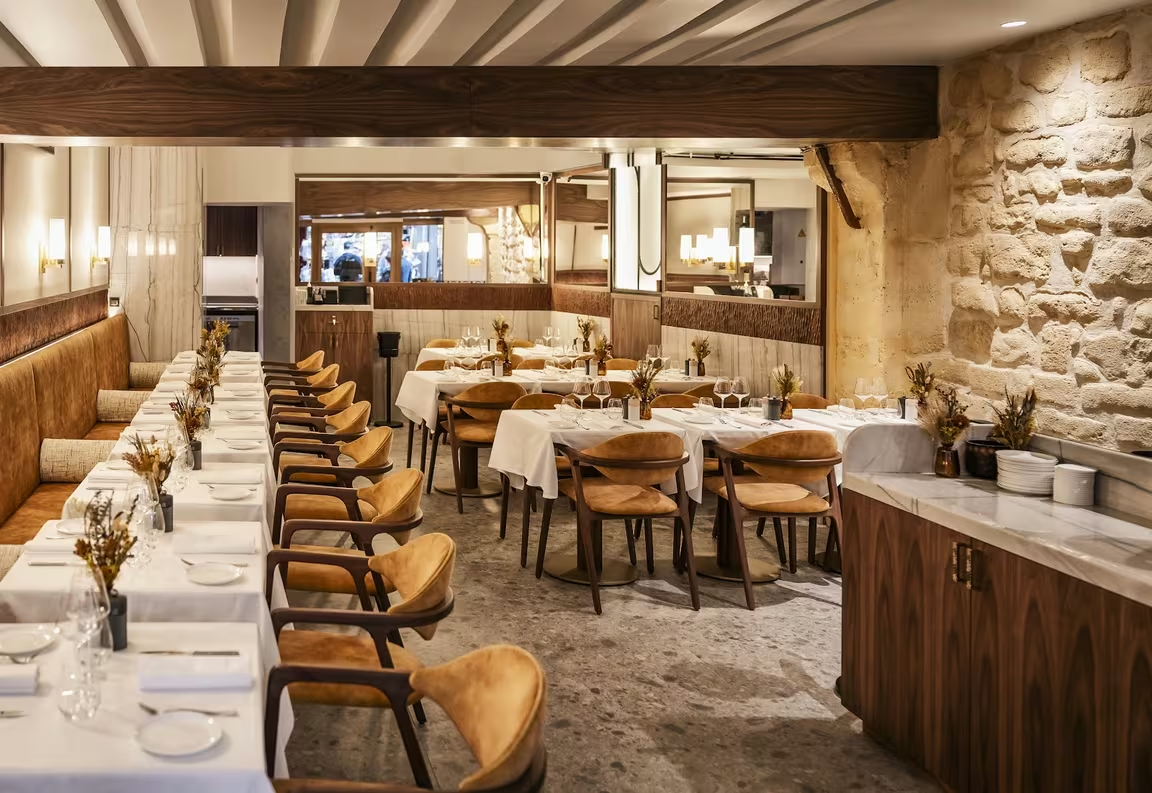
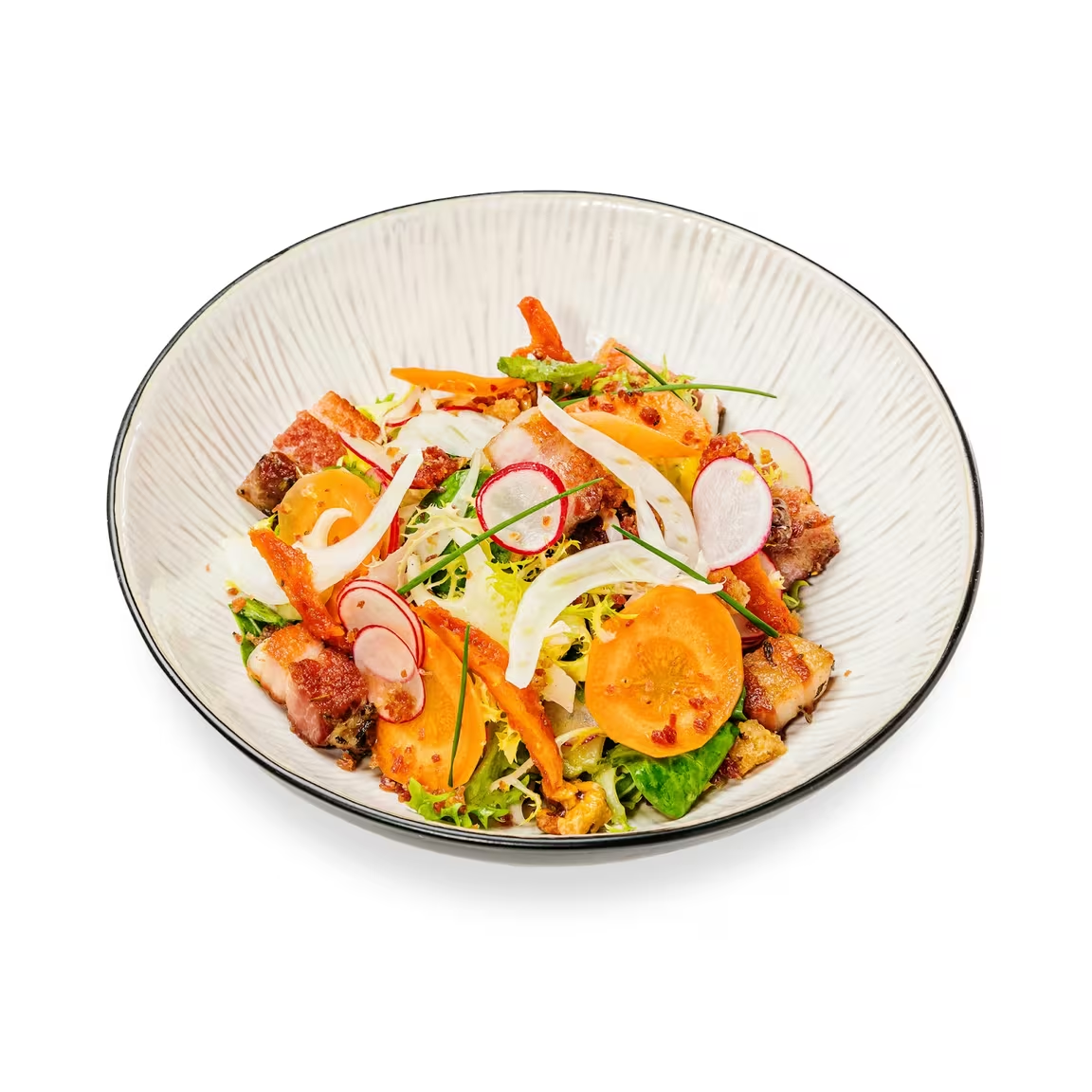
Hestia, a gastronomic restaurant nestled on rue de la Huchette near Notre-Dame, offers refined seasonal cuisine by Normandy-born chef Loïc Dantec. The establishment stands out for its barbecue cooking, precisely grilled meats, and warm atmosphere with stone walls and white beams. The carefully crafted menu features dishes like Cantal pork entrecôte and seafood, accompanied by a meticulously selected wine list. Service, managed by Filipe Fernandes, is attentive and professional, creating a gastronomic experience accessible to tourists and locals alike.
Mentions
Hestia – Paris - a MICHELIN Guide Restaurant
Hestia, goddess of the hearth, presides over this restaurant that absolutely oozes cachet, with its white beams, stone walls and mirrors. Normandy-born chef Loïc Dantec (previously at 114 Faubourg) devises a seasonal menu only, with dishes that hit the mark, such as Cantal pork entrecôte cooked over an open fire with sweet spices. All the meat is grilled to perfection on the barbecue, ready to be carved tableside. The chef cooks without showboating, making flavour the priority. His partner Filipe Fernandes competently and assiduously manages the restaurant floor.
guide.michelin.com
Hestia, Paris 5
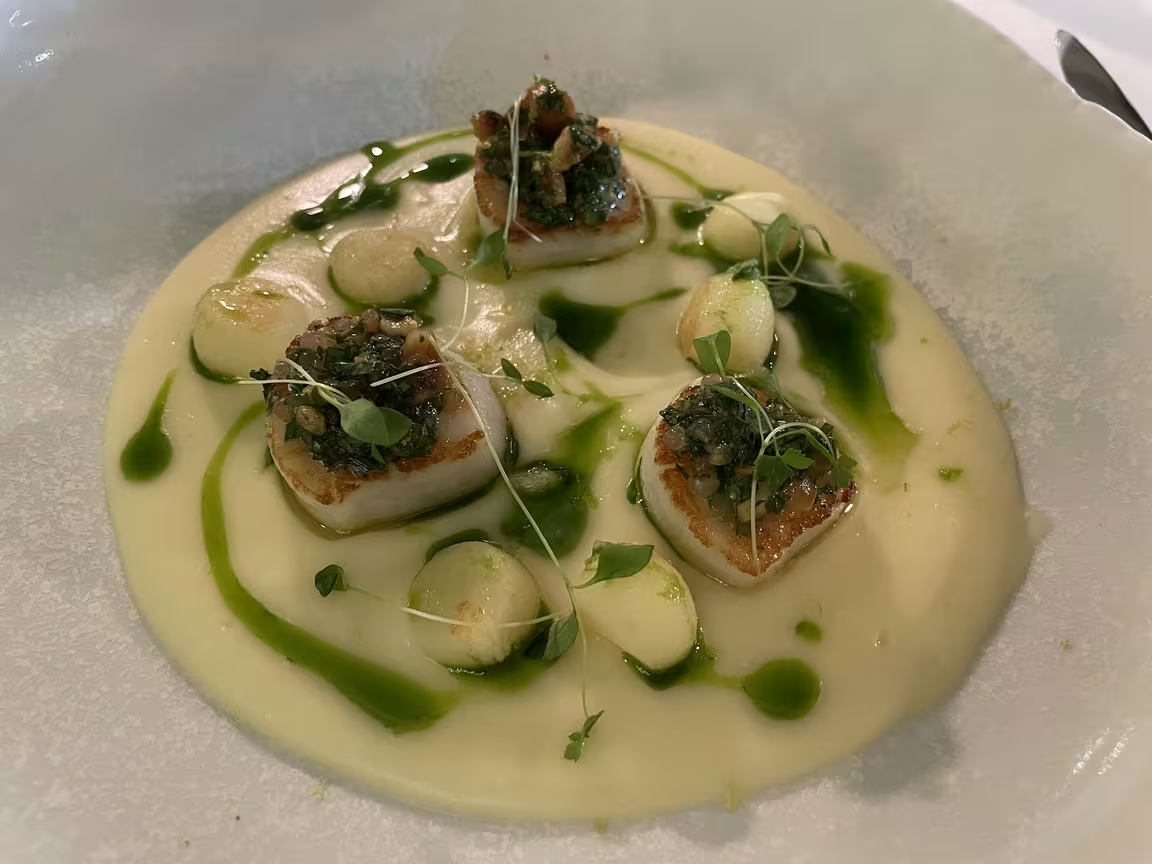
Hestia opened about six months ago. It is in one of the more unlikely locations for a restaurant of its ambition (it bills itself as a gastronomic restaurant): it is located just across the bridge from Notre Dame (250 meters walking distance, according to Google) on a street jammed with low-cost restaurants and souvenir shops. In fact, on my first visit to Paris many decades ago, I frequently lunched on 2-franc (IRRC) gyros available on this street, and the establishments are still there. Hestia’s streetfront The view up the street The restaurant is named for the Greek goddess of hearth and home. Inside, there are two rooms, one on the entry level and another downstairs: Main level of the restaurant looking out to the street Main level looking in the opposite direction Downstairs As you can see, the diners ranged from their thirties on up. Being in this location, there were understandably a number of tourists, presumably directed to the restaurant by their hotels in the area. The nationalities were quite diverse, including Portugese and Icelandic around me, and of course, some Americans. There were also French diners, but I do not know if they were Parisians or visitors. The chef, Loïc Dantec is from Normandy and worked in a number of fine-dining establishments in Paris before opening Hestia. The carte: As you can see, it is straightforward, nothing too challenging (e.g., no innards, no game except for the pigeon). The wine list is very well-chosen, extensive (considerably longer than what’s shown on the website), and reasonably priced. The list of wines by the glass: Immediately upon sitting down, I was served a selection of plump green olives while I looked over the offerings for food and wine: Then came two amuse-bouches: The one on the right was fried cheese, the one on the left included a tiny bit of foie gras. Both were of good quality. On the wine list, I spotted an excellent red Burgundy at a good price from a favorite producer located in Chambolle-Musigny. As I was dining alone, I was not going to consume the entire bottle, but in restaurants in France you have the right to take away whatever you do not finish from a bottle (and you also have the right to have the restaurant pack up any food you do not finish so you can take that away, too). So I would have half the bottle for dinner, and the other half at home the following day. The wine was not from Chambolle-Musigny, but from the hills above it. With global warming, recent vintages of Hautes Côtes de Beaune and especially Hautes Côtes de Nuits have been producing some outstanding red and white Burgundies. But because the general public has not recognized this fact yet, the wines sell at prices that do not reflect the demand and speculation that have driven up the prices on Burgundies from better-known appellations. This wine was superb, exceeding even my expectations. It was silky with complex red cherry fruit and beautifully balanced. The wine was served before my courses arrived so I could also drink it as an aperitif. For my first course, I took the watercress and haddock velouté with cream and Jamaica pepper: This was a very satisfying dish with tiny bits of haddock in the soup providing both textural and flavor contrast to the watercress soup. The brown bits you see in the picture are croutons. I did not taste the Jamaica pepper, however. For my main course, I took the roasted scallops with spinach and trumpets of death mushrooms: This, too, was a very satisfying dish with the flavors of each ingredient contributing to the whole. For dessert, I took the blanc mangé (sic) with clementine, crème anglaise with juniper, and mint ice cream: The dish was light with good purity of flavors. It was overall harmonious, and it was not overly sweet (one of the things I like about desserts in France). Mignardises after the meal were light and satisfying, too: And the bottom line (recall, that I took away half the bottle of wine): Given its tourist clientèle, Hestia provides very good cuisine at a level of quality and refinement that many visitors to Paris otherwise would not experience. Additionally, the setting is warm and the service is excellent and friendly (the staff speaks fluent English, but will not force it upon you if you wish to speak French). It is a very good choice if you are looking for a quality restaurant near the absolute center of Paris and have diners who do not want to engage in food that is too challenging and/or want French food that is more international in conception than many of the other places I visit. I'm sure I will be back. Hestia 8, rue de la Huchette, 75005 Paris Tuesday-Saturday lunch and dinner Tel: 01 84 74 95 20 website: https://www.hestia-restaurant.com/en/ Métro: Saint-Michel Notre Dame, Cluny La Sorbonne Thanks for reading The Fine Wine Review! This post is public so feel free to share it. Share
thefinewinereview.substack.com
All the New MICHELIN-Star Restaurants in Paris & Culinary Trends for 2025
On Monday March 31, 2025, the new restaurant selection was announced for The MICHELIN Guide France. Among the announcements made on the night was a wave of exciting news about the Paris dining scene. With a multitude of new MICHELIN-Star restaurants in Paris unveiled, along with other exciting new openings, here we dive into the headlines and what they say about the current culinary landscape in the French capital. Firstly, let's give a warm welcome to the two Parisian restaurants that have joined the prestigious Two-Star family. Within the refined interior of Sushi Yoshinaga, in which sycamore maple woodwork meets Japanese ceramics, master sushi chef Tomoyuki Yoshinaga works wonders with fish of exceptional quality. Behind his counter in this intimate setting, he prepares fatty tuna and other seafood ingredients with the precision of a jeweler, using textures, maturation, and seasoning to great effect. His omakase menu, which showcases his own creations and house-made sauces, is to be relished in a friendly atmosphere that is expertly cultivated by the chef and his maître d'. Meanwhile, Chef Shinichi Sato, who made a big impression at Passage 53, is now pursuing his art to the same exacting standards at Blanc. Exceptional ingredients, technical precision, and harmonious flavors culminate in masterful dishes, from Finistère sea urchin to monkfish with ginger. A remarkable wine cellar, particularly the selection of burgundies, and a cozy bar stocked with top-drawer whiskies round off this outstanding overall experience. Read more: The Full List of Every MICHELIN-Star Restaurant in Paris NEW RESTAURANTS FROM FAMILIAR FACES Some much-loved chefs we remember from bygone times and restaurants past have been making a jubilant return. Marc Favier has opened Le Tire-Bouchon Rodier, having held One MICHELIN Star at Marcore; Loïc Dantec, previously at 114, Faubourg, has established Hestia; and Takuya Watanabe, formerly of Jin, has joined Hakuba, where he continues his masterclass in the art of sushi. With 19 Saint Roch, Pierre Touitou, beloved of discerning foodies, has also come back into the limelight. Meanwhile, Agapé, run by incomparable talent scout Laurent Lapaire, has retrieved its MICHELIN Star, as has Sushi Shunei. RISING STARS Alongside these familiar faces, a talented new cohort is reaching for the stars. Among them, Chef Youssef Marzouk's Aldehyde, Cecilia Spurio and Eugenio Anfuso's Amâlia, Adrien Cachot's Vaisseau, and Julien Boscus's Origines Restaurant are all bringing an invaluable surge of energy to the Parisian culinary landscape. BIG NAMES, SMALL SPACES Some of France's most renowned chefs are continuing to showcase their expertise at restaurants beyond their flagships. Frédéric Anton, for instance, has opened La Ferme du Pré, while Alain Ducasse has put his stamp (and, needless to say, his name) on Ducasse Baccarat. Jean-François Piège is back with a pasta restaurant, Clover Saint-Germain; Grégory Marchand (Frenchie, One Star) is serving up his personal interpretation of Italian cuisine at L'Altro Frenchie; and Chef Sylvain Sendra (Fleur de Pavé, One Star) has opened Petrus, a quintessential Parisian bistro serving meticulously crafted cuisine. Elsewhere in the French capital, Alan Geaam (One Star) has developed a vegetarian version of his Lebanese fare at Qasti Green, where some of the dishes have already acquired classic status, such as the celery and mushroom shawarma, or the daoud bacha (spicy lentil dumplings with almonds in tomato sauce). HIT RESTAURANTS BRANCHING OUT Some of the city's most beloved restaurants are expanding their businesses, with either major or minor tweaks to their original concept. Calice, opened by the owner of Baillote, is a case in point. So is L'Évadé, which is almost identical in formula to L'Escudella; but why change a recipe that works? Following on from Les Résistants, just a few hundred meters away, Les Résistants - La Table is building on the success of its precursor, upping the ante in the gastronomic stakes, while retaining the affordably priced set lunch menu. With Super Huit, the team from Mieux strikes again, transforming a corner café in a well-heeled Parisian neighborhood into a fashionable bistro. Finally, Chef Thibault Sombardier, already a chef-restaurateur in his own right with Mensae and Sellae, has gone on to open an authentic Korean restaurant, Mojju. GLOBAL CHEFS SETTLING IN PARIS Paris's international appeal has only been bolstered by the success of the 2024 Olympic Games, meaning that it continues to attract chefs from all over the world. Maksym Zorin, for example, is a Ukrainian chef turning his hand to French cuisine at La Datcha. At Matka ("mother" in Polish), Piotr Korzen introduces his refined vision of Polish cuisine in a space with a magnificent ceramic stove, reminiscent of Eastern European kitchens. As for Israeli cuisine, Assaf Granit has transformed Balagan into Kapara, a buzzing and bustling eatery where you're never quite sure if the food inspires the singing, or the singing inspires the food! Meanwhile, Elior Benaroche, previously Assaf Granit's Sous Chef and associate, has opened Adraba. GREAT RESTAURANTS IN QUIRKY LOCATIONS Brilliant food can be found in just about any location, including the most distinctive of spots. At Habile., fashion and food unite under one roof; the chef cooks on the ground floor while his stylist partner exhibits her sartorial creations upstairs, so don't be surprised to see jars of gherkins displayed between the outfits. Halo Paris, hidden away at the back of a concept store, is a fusion of cuisine and culture; designed as a cultural hub, the space has a small exhibition room, cocktail bar, and table d'hôte in the basement. THE UNSTOPPABLE PARISIAN BISTRO For all its innovation, Paris continues to celebrate the traditional bistro spirit, with a new wave of laid-back gourmet haunts showing that this beloved style of dining is going nowhere. Bistro dining all about smart, hassle-free pleasure, and in 2025 its supporters are creating delightful establishments out of unlikely locations, such as drab betting shops, their walls once discolored by cigarette smoke. The winning bistro formula is tried and tested: a youthful team or a young couple who have earned their stripes in prestigious establishments (or alternatively graduates from other industries who have followed their hearts and made a career pivot), often a set lunch at a reasonable price, a more robust tasting menu in the evening, and, crucially, fresh, top-notch ingredients, prepared with technical expertise for maximum flavor. From iconic Parisian bistros (such as Capsule) to more resolutely modern settings, authentic, accessible cuisine is the name of the game. Petrus, Phébé, L'Arpaon, Le Matré, and Le Boréal are all putting a generous new spin on tradition; Erso and Faubourg Daimant are exploring contemporary approaches, the latter serving a vegetarian version of bourgeois French cuisine; BRU, Le Tire-Bouchon Rodier, and Super Huit have a neo-bistro feel about them; and Bistrot des Fables brings a certain elegance to its dishes. Another example of the ongoing bistro trend is Paulownia, run by a couple who cut their teeth under Alain Passard. The restaurant's atmosphere is nothing if not convivial, which is largely down to the genial front-of-house team always providing their service with a smile. There's a complete lack of pretentiousness here: just that true Parisian bistro spirit, that special something that smacks of authenticity. The kitchen uses the same suppliers as top-flight establishments and the menu changes with the seasons. In 2025, Paris is once again proving that when it comes to eating out, there are few places better. It is a city with no culinary boundaries, and a place that's never short of ideas. From inspired comebacks and new MICHELIN Stars to idiosyncratic settings and buoyant bistros, the French capital's dining scene has it all. After all, its restaurants are not
guide.michelin.com