L'Écurie
Restaurant — La Sorbonne (Paris)

À propos
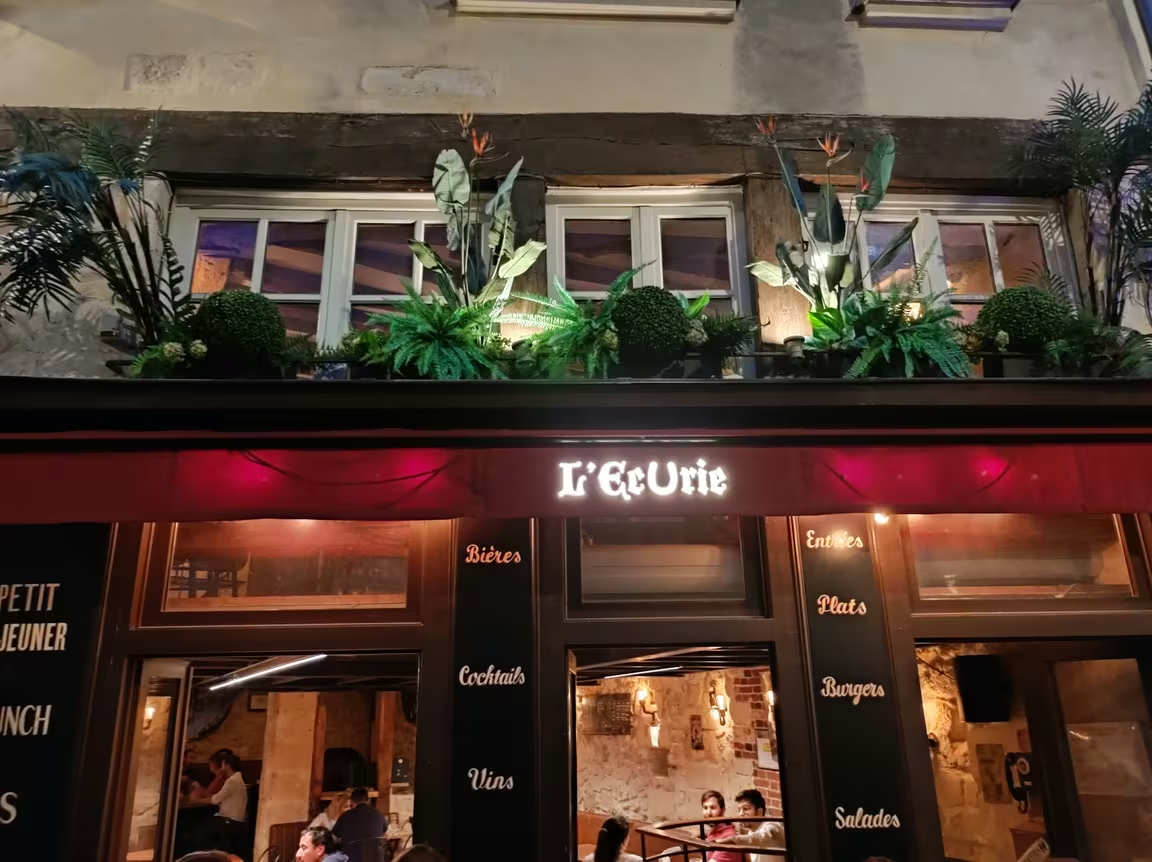
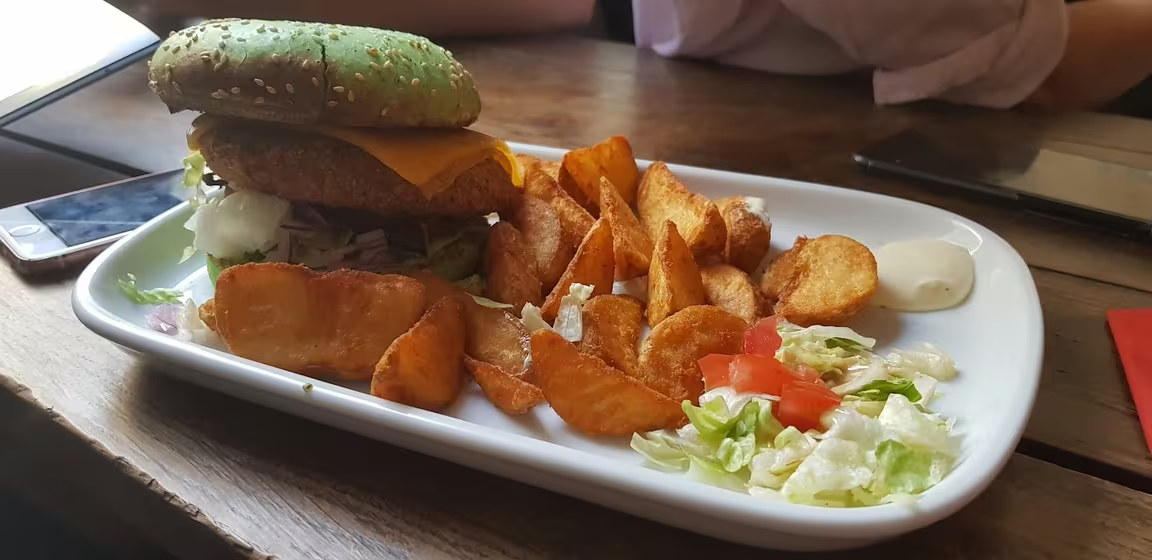
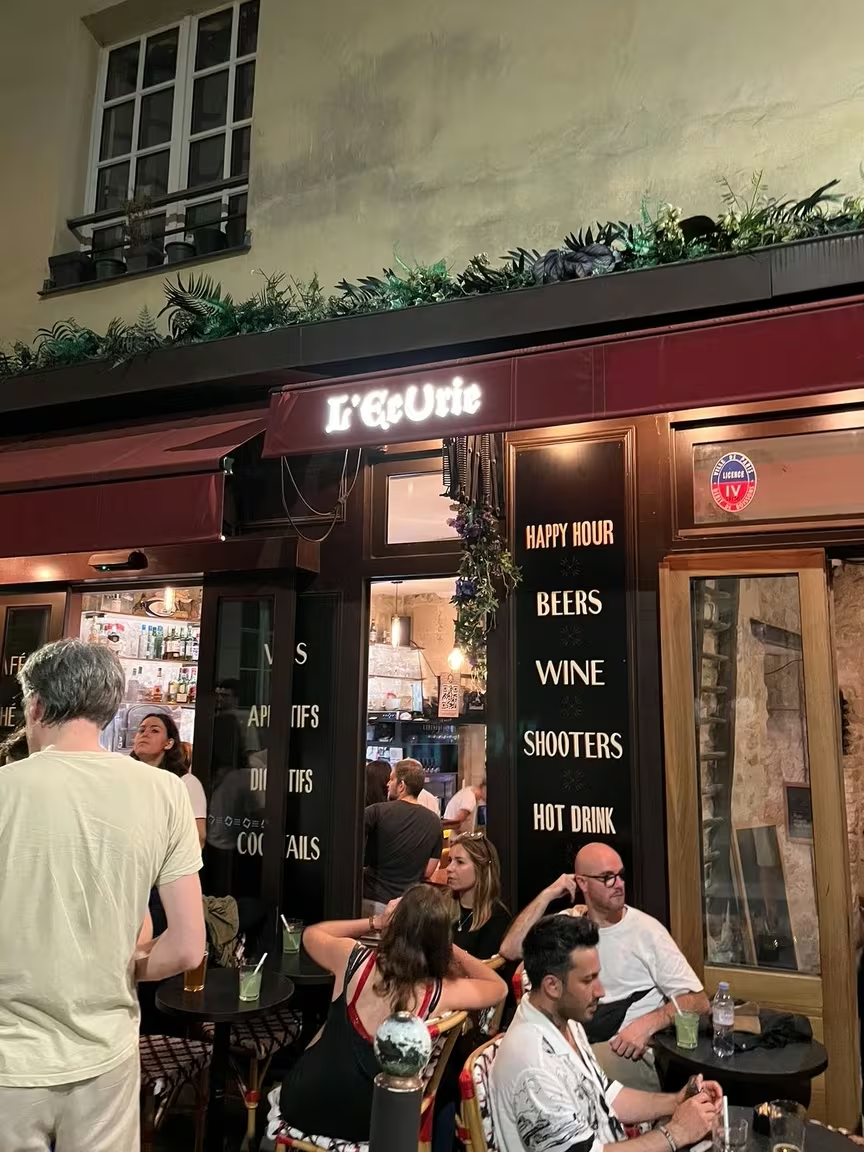
L'Écurie est un restaurant traditionnel parisien niché dans le 5ème arrondissement, installé dans un bâtiment historique datant du 16ème siècle. Spécialisé dans les grillades et les viandes, ce lieu authentique propose une cuisine simple mais savoureuse, avec des classiques comme la côte de bœuf, les steaks et des plats servis dans une ambiance conviviale. Le restaurant est réputé pour son accueil chaleureux, ses portions généreuses et son cadre atypique en cave voûtée. Un pichet de vin, une sangria offerte et un digestif complètent l'expérience. Les prix sont abordables et l'établissement conserve un charme vintage qui rappelle les bistrots parisiens traditionnels.
Mentions
Restaurant L'Ecurie Paris 5 �me | Restoaparis.com
* Guide Restaurant * Paris * Restaurant Fran�ais * 5 �me * L'Ecurie Toujours des diners agr�ables � l'�curie o� on ne se rend pas forc�ment pour la qualit� du service (qui peut �tre un peu long s'il y a du monde) mais parce que l'on a envie de prendre son temps pour diner, que ce soit en amoureux ou � plusieurs. Vous y trouverez principalement des viandes grill�es au feu de braise (notamment la c�te de boeuf pour 2) servies avec des frites maison. Le vin est bon et l'ambiance toujours bonne surtout en sous-sol (ce sont des pi�ces vout�es). La sangria est offerte, tout comme le digestif. Bref, un resto o� on ne se prend pas la t�te et o� on est s�r de manger correctement et � sa faim. D'AUTRES RESTAURANTS � PARIS QUI VONT VOUS PLAIRE ! LES NOUVEAUX RESTAURANTS 75CL Au cœur du 1er arrondissement, � deux pas du Louvre, 75CL s’affirme comme le nouveau repaire des amateurs de vins et d’assiettes pleines de caract�re. Pens� comme un bar � vins nouvelle g�n�ration, l’endroit m�le avec naturel expertise œnologique, ambiance d�contract�e et clin d’œil � la bistronomie hexagonale. L'article LA GATINAISE Le restaurant bistrot la Gatinaise est devenu le quartier g�n�ral du�centre commercial Mass�na�du Paris 13 �me. Dans sa salle rest� dans son jus vintage et sa terrasse lumineuse, on s'y r�gale d'une cuisine Fran�aise traditionnelle avec de bonnes grillades et le fameux couscous du chef. L'article TANGUERA Une petite maison Argentine et P�ruvienne dans le Paris 11 �me qui propose une cuisine g�n�reuse et qui fait voyager ! Aux commandes du restaurant : Lorena, une h�te pleine d'�nergie qui vous plongera dans l'ambiance sud am�ricaine. L'article LOJO Un petit joyau bistronomique nich� dans le 9�me, qui r�invente la gastronomie fran�aise dans une ambiance chaleureuse. La cuisine raffin�e du Chef sublime les produits de saison avec une pr�cision remarquable. L'article L'ATTILIO L’Attilio c'est une exp�rience gastronomique franco-italienne au cœur du 8 �me arrondissement de Paris, laissez-vous emporter par la cr�ativit� du Chef Attilio Marrazzo. Dans son arestaurant au cadre �l�gant et chaleureux, sa cuisine fusionne le raffinement de la gastronomie fran�aise avec la g�n�rosit� des saveurs italiennes. L'article YUKGA Yukga est un restaurant cor�en authentique au cœur de Paris pr�s de Bastille, sp�cialis� dans le barbecue cor�en. Yukga vous invite � d�couvrir l’art de la grillade � table dans une ambiance chaleureuse et conviviale. L'article
restoaparis.com
Whitings Writings - Paris Bistros - L'Ecurie
L'Ecurie From Through Darkest Gaul with Trencher and Tastevin, 1997: ---------------------------------------- Charles Shere’s Three Weeks in Paris 1977 contains on the first page the following entry: Sophie returned, then F., & we walked up Mouffetard to L’Ecurie in rue du Mont S. Geneviève for dinner [160]: we had Salade de tomate Paté saucisson selle, côte d’agneau & chateaubriand crèpes aux poires flambé vin en pichet If I read this correctly, that was a three-course dinner for four, including wine, for 160 francs—cheap even twenty years ago. Last year Charles returned and found the restaurant unchanged except for the prices, and those had not kept pace with inflation. These are the very restaurants that are fast disappearing, and so a visit was mandatory. I went on a sunny evening (one of the few this sodden summer) and found an ancient seedy building whose decor, inside and out, could best be described as Dickensian Hippie. The facade was the sort of black which might have begun decades ago as any other color, with decoration which included a couple of brightly-painted cartoons and an amazing tattered photo of an ancient bearded gentleman on an enormous tricycle, a parodic Horseman of the Apocalypse. Over the sidewalk hung a sign with a stylized representation of a strutting Etruscan stud. The tables inside were crowded and higgledy-piggledy, so I opted for a small table on the sidewalk in the sun with the grill just the other side of an open window. There I could enjoy everyone else’s dinner as well as my own. I was immediately brought a glass of sangria, a basket of bread, and a generous dish of aïoli which must have kept the staff occupied all day crushing the garlic. The aroma wafting through the window told me that my first course had to be grilled marinated sweet peppers and tomatoes, brushed with the marinade and sprinkled with basil. These proved to be succulent even beyond expectation. For a main course I settled on grilled lamb chops and French fries and was rewarded with lamb which tasted simply of lamb and fries which tasted of potato. My only mistake was to pass up the house wine for an indifferent Provencal rosé. Subsequently I would adopt the maxim, Don’t stray From the cliché, Just stay With the pichet! At the end of a leisurely meal I was brought a glass of calvados. (Like the sangria, it came with the territory.) By then the restaurant had filled up and a young couple with a baby, evidently friends of the staff, were regretfully informed that there was no room in the inn. Observing a star in the East, I stood up and offered them my table, which they gratefully accepted. Conversation revealed that he was himself a restaurateur, in charge of a riverside restaurant at the Bastille which was mentioned in one of my guide books. It was his night off. I was reassured; “Eat where the chefs eat,” is my motto. He proved to be very familiar with L’Ecurie and knew something of its history. The building itself, he thought, went back to the 16th century and the ground floor had been a restaurant for at least a hundred years. I would later discover that the bar inside was an original zinc. This was the metal from which they were usually made, so that it became the generic term even when the bar was wood or even plastic. Alas, this became common during the last war, when almost all of the zinc bars were melted down by the Germans. This is one of the few to survive, and the maker’s seal is evidence that it dates from just after the Great War (as opposed to the others). My informant went on to tell me that L’Ecurie was noteworthy for the excellence of its meat and also its super gambas. I would be able to verify this at lunch the following day. Not wanting to suffer the near-fate of my new acquaintances, I made a reservation for one o’clock. But first I would have to move from my luxury hotel in the 1st Arrondisement, paid for by IRCAM, the computer music research center established by Pierre Boulez—the great good place where worthy electroacoustic composers go when they die. Since I was remaining in Paris between weekends at my own expense, I opted for a B&B on the south edge of the Latin Quarter. Back at my sidewalk table, soon to bear my name on a brass plaque, I ordered the super gambas. Four of them arrived on a large platter. They were are biggest king prawns I’d ever encountered; I would have hesitated to engage them, live, in single combat. Chewy and succulent, they were a meal in themselves, but were nevertheless accompanied by an enormous baked potato, which I had discovered was an optional substitute for the fries. Having chosen the low-fat alternative, I proceeded to drown it in aïoli. I’m a true American: I always drink calorie-free Badoit with my Ben & Jerry’s super-rich vanilla ice cream. As I ate my lunch an over-decorated woman of a certain age was pulled past me, as if on wheels, by three identical toy dogs on identical leashes. She had also passed by the evening before. I was beginning to feel at home. ON A ROLL (to coin a phrase), I booked dinner for seven-thirty that evening. I was to meet James Wood, a fine English composer with whom I’ve worked for twenty years. James is someone I have always bitterly resented. Possessing a voracious appetite for fiery vindaloos, he has been known to tuck into my left-overs; and yet he could model for an Oxfam poster. The explanation must be metabolic. (I refuse to accept the alternative that he simply works harder than I do.) James had the incredible fortune of working in Paris for a month on a new piece at IRCAM. With his world reputation as a lover of good food, introducing him to L’Ecurie could guarantee its survival well into the next millennium. I began by following James’ example, a blue cheese salad. It was a simple large bowl of lettuce with a creamy blue cheese dressing, and then a surprise at the bottom, some more crumbled bits of blue cheese. This is contrary to the usual restaurant practice, which is to fill the bowl with lettuce and then put the expensive bits on top where they’re visible. A whole day’s crab salads may thus be gleaned from a single crustacean. My main course was again lamb, but this time a grilled slice of leg cut straight through the bone. Both these courses plus a desert (my choice being a cassis sorbet packed with bits of ripe fruit), were among the alternatives in the bargain menu at 98 francs. When was the next time I could make an excuse to return? What about the following evening, when I was to meet T. Wignesan, the Stateless Civil Servant? (That’s the title under which I’ve told him he must publish his autobiography.) Wignesan (who refuses to divulge what the T stands for—is it perhaps his Tantric identity?) is a research fellow in comparative literature and was a long-time friend of the late poet and scholar Eric Mottram. Friends of Eric belong inexorably to a world-wide club from which, like the Catholic church, there is no resigning. I knew Wignesan to be a vegetarian, but I had no compunctions about bringing him here and steering him towards the aïoli and the grilled peppers, while I had a salade de tomates. This is a simple dish which Waverley Root used to choose as a means of testing a restaurant. If the waiter raised his eyes in haughty disdain and brought an unadorned dish of sliced tomatoes, the establishment failed. L’Ecurie passed easily with a generous plate of ripe fruity slices discreetly dressed and herbed. Being a tolerant man and possessed of a long-suffering wisdom, my companion watched without impatience as I gobbled down a grilled skewer of lamb, peppers and onions. Our reminiscences of Eric took us late into the night. By the time we left I was almost rooted to my now-familiar spot. Perhaps I shall leave provision in my will that I am to be embalmed and, like the corpse of Jeremy Bentham, seated in a glass cage from which I may preside over this venerable institution for all eternity. IT WAS several days before I would ret
whitings-writings.com
Restaurant L’Ecurie: 58, rue de la Montagne Ste-Geneviève, 5eme ~ Red wine, a good paté de campagne and Steak Frites. Hemingway … | Paris, Belle époque, Bistronomie
Restaurant L’Ecurie: 58, rue de la Montagne Ste-Geneviève, 5eme ~ Red wine, a good paté de campagne and Steak Frites. Hemingway … | Paris, Belle époque, Bistronomie Explore Search for easy dinners, fashion, etc. When autocomplete results are available use up and down arrows to review and enter to select. Touch device users, explore by touch or with swipe gestures. Log in Sign up Download image MEDIEVAL RESTAURANT Restaurant L’Ecurie: 58, rue de la Montagne Ste-Geneviève, 5eme ~ Red wine, a good paté de campagne and Steak Frites. Hemingway lived around the corner. It was a former stable on a corner of Rue Montagne Saint-Geneviève– the street Woody Allen filmed Midnight in Paris Joan COMMENTS MORE ABOUT THIS PIN Explore Travel Travel Destinations Europe Destinations BOARD CONTAINING THIS PIN Paris Restaurants & Cafes 1.2k Pins 3y RELATED INTERESTS Medieval Restaurant Medieval Style Restaurant Medieval Fast Food Medieval Restaurant Ambiance Medieval Town Cafe Atmosphere French Creperie Exterior La Perouse Paris Medieval Times Restaurant Traditional French Creperie
pinterest.com